If you have been wondering why your blog content is not ranking the way it used to, or why your competitor with weaker domain authority keeps outranking you, the answer is almost always E-E-A-T. It is the framework Google uses to decide which sites deserve to show up in search results, and over the past two years it has reshaped the entire content marketing industry.
For local businesses, understanding E-E-A-T is no longer optional. It is the difference between content that ranks and content that sits buried on page seven, invisible to the customers searching for exactly what you offer.
What does E-E-A-T stand for?
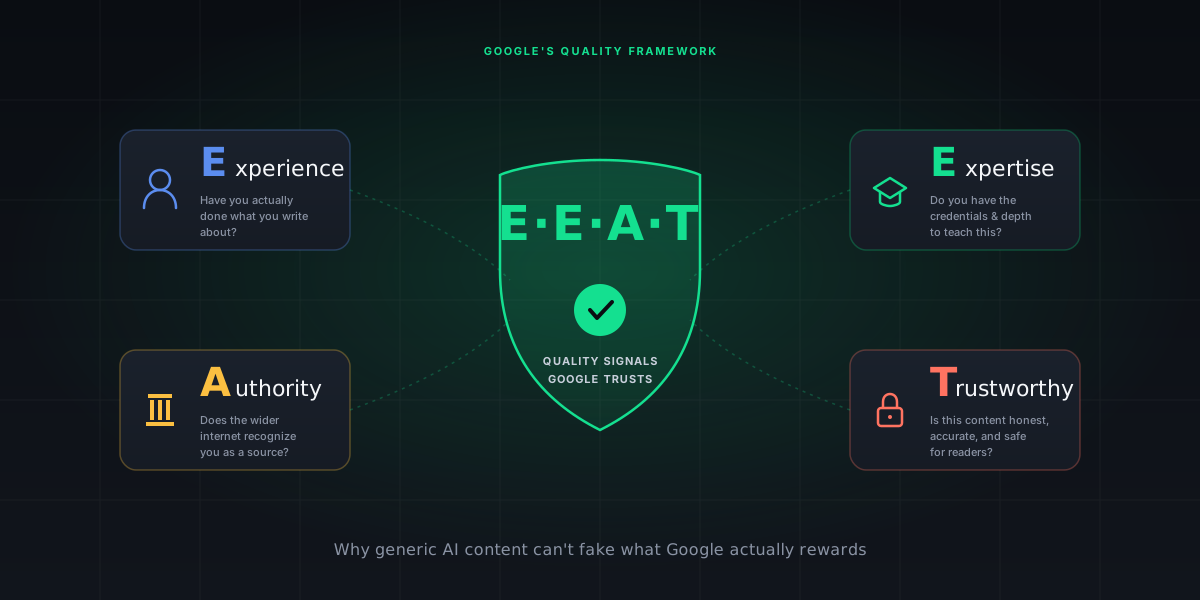
E-E-A-T is an acronym Google uses internally and in its Search Quality Rater Guidelines to evaluate content. It stands for Experience, Expertise, Authoritativeness, and Trustworthiness. The original framework was just E-A-T. Google added the second E for Experience in December 2022, which was a direct response to the flood of AI-generated content hitting the web.
Here is what each piece actually means in plain English.
Experience
Has the person writing this content actually done the thing they are writing about? A dentist writing about root canals based on having performed thousands of them brings something an AI cannot fake. First-hand experience is the layer Google added in 2022 and the one cheap content cannot replicate.
Expertise
Does the author have the credentials, training, or deep knowledge to teach this topic? For medical and legal content, this means real qualifications. For other topics, it means demonstrated mastery shown through depth, precision, and accurate use of industry-specific terms.
Trustworthiness
Is the content accurate, transparent, and safe for readers? Trust is the foundation of the whole framework. A site can have all the other signals and still fail if its information is misleading, its citations are fake, or its claims could harm people who follow them.
Why E-E-A-T matters more in 2026 than ever before
Between 2022 and 2024, the internet was flooded with AI-generated content. ChatGPT, Claude, and dozens of other tools made it possible for anyone to produce thousands of articles a day. Cheap content agencies started shipping these articles to clients at $50 a piece. Sites that paid for this content saw a brief spike in pages indexed and then a collapse in rankings as Google rolled out its Helpful Content Update.
The reason is simple. AI is great at producing fluent text. It cannot produce experience. It cannot fake real patient stories. It cannot draw on a chiropractor's twelve years of treating runners. It cannot speak to what a dental hygienist sees in patient mouths every Tuesday morning. That is the gap E-E-A-T is designed to detect.
If your content reads like every other site's content, Google has no reason to rank you above them. If your content carries the fingerprints of a real expert who has actually done the work, Google notices.
What E-E-A-T looks like in practice
Here is a side-by-side comparison of how the same topic gets covered with and without E-E-A-T signals.
Without E-E-A-T
"Root canals are a common dental procedure used to treat infected tooth pulp. They are generally safe and effective. Patients should consult their dentist if they experience tooth pain. Recovery time varies."
With E-E-A-T
"I have performed over 1,200 root canals in my fifteen years of practice. The two questions every patient asks me are 'will it hurt?' and 'how long does it last?' Here is what I tell them, based on what I have actually seen across those 1,200 cases."
The first version is generic. It is also exactly what ChatGPT would produce if you asked it to write a paragraph about root canals. The second version could only have been written by the dentist who lived it. Google can tell the difference. So can the reader.
How E-E-A-T applies specifically to local service businesses
For local service businesses, E-E-A-T is actually easier to build than it is for big national publishers. Here is why.
Experience: you already have it
You have been doing this work for years. You see the same questions from patients or customers every week. Every blog post should start with a real story or example from your practice. Not "many patients ask" but "Mrs. Chen called me last Tuesday with..." That specificity is the Experience signal.
Expertise: prove it on the page
Every article should have a byline. The byline should include credentials, a real photo, and a link to a real about page with biography, training, and licensure. If the article is about a medical or legal topic, link to a primary source like the CDC, FDA, AMA, or the relevant professional association. Cheap AI content almost never does this.
Authority: it builds slowly, then suddenly
Authority is the hardest signal to build, but the most defensible once you have it. It comes from publishing consistently for one to two years, getting cited by other local sites and directories, accumulating positive reviews on Google and industry-specific platforms, and being the answer for your local market on a clearly defined set of topics.
Trust: this is the easy one
Have a real about page. Include your address, phone number, and license number if you have one. Display real Google reviews. Cite your sources. Do not make claims you cannot back up. Use HTTPS. These are basic, but they are the trust signals Google looks for and cheap content sites usually fail at.
The connection between E-E-A-T and the Helpful Content Update
Google's Helpful Content Update, which rolled out in major waves throughout 2023 and 2024, is essentially the algorithmic enforcement of E-E-A-T. Sites that fail the framework get demoted. Sites that pass get rewarded.
The pattern is consistent. Sites that grew on the back of AI-generated content during 2022 saw 30 to 80 percent traffic losses across multiple Helpful Content Updates. Sites that built around real expert voices, original first-hand experience, and proper editorial standards have gained ground at their expense. This is not slowing down. Google has stated publicly that helpful content is now a permanent ranking factor.
If you read about agencies that show clients sudden traffic crashes, this is almost always why.
How to evaluate your own content against E-E-A-T
Pick three articles from your current blog. For each one, ask yourself these questions:
- Could a smart college student with no experience in your industry have written this? If yes, the article is missing Experience signals. Add real examples from your own practice.
- Does the article have a byline with credentials and a real photo? If no, you are missing Expertise signals. Add an author block.
- Does the article cite at least one external authoritative source? If no, you are missing Trust signals. Link to one or two primary sources.
- Would a reader who finished this article want to read another from the same author? If no, the voice is too generic. Rewrite in your own voice.
- Does the article use industry-specific terms correctly? Vague language is a tell. Precise terminology is an Expertise signal.
Most blogs from local businesses fail four out of five. That is actually good news, because the fix is not technical. It is editorial.
For more on what cheap content agencies do that violates these principles, see our piece on 7 red flags to watch for when hiring a content agency. And if you want to understand the broader picture of how Google decides who ranks first in your local market, we covered that here.
Does your existing content pass E-E-A-T?
Get a free content audit that scores your blog against all four E-E-A-T pillars. We tell you exactly which articles are at risk and what to fix. Branded PDF, yours to keep.
Request Free AuditFrequently asked questions
