Most business owners think Google's ranking algorithm is some kind of mysterious black box. It is not. The local algorithm specifically is built around three factors that have been public knowledge for over a decade. Once you understand them, the work to rank higher becomes obvious.
This article breaks down exactly how Google decides who shows up first when someone searches for a service in your town. We will skip the jargon, skip the marketer talk, and tell you what actually moves the needle.
The three factors that decide local rankings
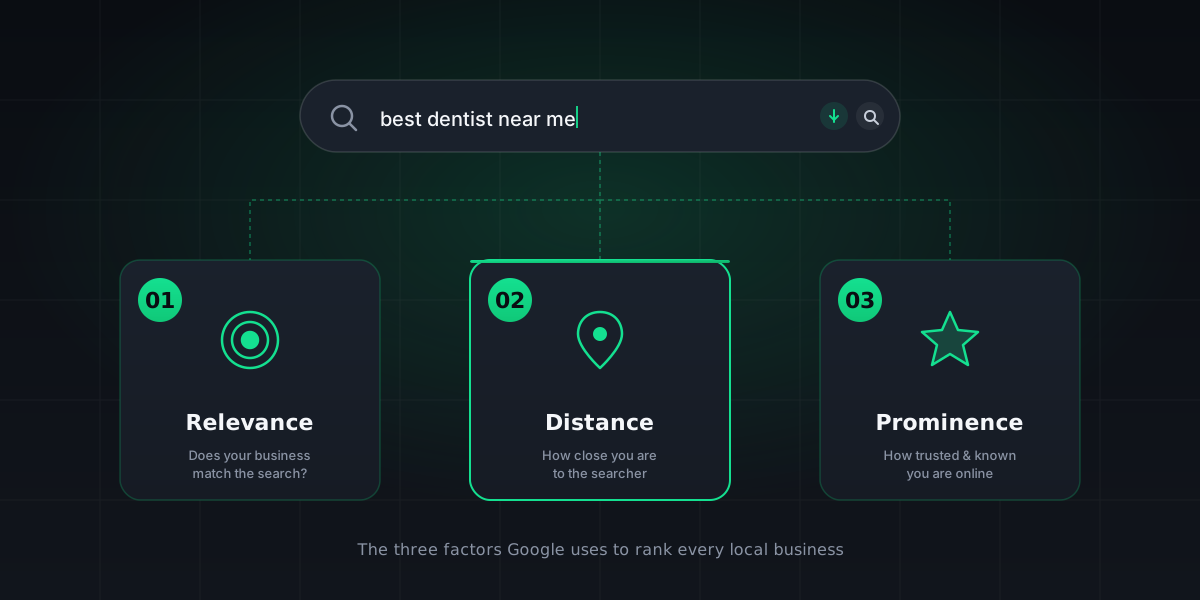
Google has openly stated that local search rankings come down to three things: relevance, distance, and prominence. Every other tactic you have heard about (keywords, reviews, citations, content, backlinks) feeds into one of these three buckets.
Relevance
How well your business matches what the person searched for.
Distance
How close your physical location is to where the searcher is.
Prominence
How well-known and trusted your business appears to be online.
Those three words are the entire system. Now let us break each one down so you understand what to actually do.
Relevance: Does your business match what people are searching?
Relevance is the easiest one to influence and the one most local businesses get wrong. When someone in Morristown searches "auto accident chiropractor," Google needs to figure out which businesses in that area are most clearly about auto accident chiropractic care.
If your website only says "We are a chiropractor in Morristown," Google has no specific reason to favor you for an auto accident search over the chiropractor down the street whose website explicitly mentions auto accidents, whiplash, and personal injury recovery in their content.
Three things signal relevance to Google:
- Your service descriptions. Each service you offer should have its own page or section with detailed content about what it is, who it helps, and what to expect.
- Your blog content. Articles targeting specific search terms tell Google "this site is an authority on this topic." A chiropractor with 15 articles about auto accident recovery looks more relevant than one with zero.
- Your Google Business Profile categories. The categories you choose in your profile (primary and secondary) directly tell Google what searches you should appear for.
Most local businesses pick one primary category in their Google Business Profile and never add secondary categories. They also have homepage copy that says something generic like "Quality service since 2015." Both moves tank relevance.
Distance: Where you actually are matters
Distance is the factor you have the least control over because you cannot move your office. But there are still three things to know.
First, distance is calculated from the searcher's location, not yours. If someone is standing in downtown Morristown and searches "chiropractor near me," Google ranks businesses by distance from where that person is right now. A business 0.3 miles from the searcher will outrank a better business 5 miles away for that specific search.
Second, the search query itself can override or weaken the distance factor. If someone searches "best chiropractor in New Jersey," they are signaling they want quality more than proximity, and Google adjusts. If they search "chiropractor open now," they are signaling immediacy, and Google prioritizes nearby options that are currently open.
Third, having multiple location signals helps. Your address listed on your website (in the footer or contact page), your address consistent across Google Business Profile, Yelp, and other directories, and your service area listed in your Google Business Profile all reinforce where you are and who you serve.
Prominence: Are you a known and trusted business?
Prominence is where the long-term work happens. Google evaluates how prominent your business is by looking at signals from across the entire web, not just your website.
The biggest prominence signals:
- Reviews. Both quantity (how many reviews you have) and quality (your average rating) matter. A practice with 250 four-star reviews will often outrank a practice with 8 five-star reviews because volume signals trust.
- Citations. Citations are mentions of your business name, address, and phone number on other websites. Yelp, Healthgrades, Avvo, Angi, the Better Business Bureau, your local Chamber of Commerce. Each consistent citation reinforces that you are a real, known business.
- Backlinks. Links from other reputable websites pointing to your site. These are harder to earn and easier to overdo (which can hurt you), but a few quality backlinks from local newspapers, professional associations, or industry publications boost prominence significantly.
- Brand searches. When people search for your business by name, Google notices. The more people who search for "your business name" specifically, the more prominent Google considers you.
- Content authority. A website with deep, original content on relevant topics signals expertise. This is where blog content directly contributes to local rankings.
Local pack vs. organic results
One thing that confuses business owners is the difference between the "local pack" (the three-business box with map pins at the top of local searches) and "organic results" (the regular blue links below).
The local pack is heavily weighted toward distance and Google Business Profile signals. Organic results are weighted toward content, authority, and backlinks. Both matter for different reasons.
If you only optimize your Google Business Profile and ignore your website content, you might rank in the local pack but disappear from organic results. If you only build content and ignore your Google Business Profile, you might rank for keyword-driven searches but miss out on "near me" traffic. The best local SEO strategies cover both.
What this means for your business
Now that you know the three factors, here is the practical takeaway. To improve local rankings, you need to:
- Make your relevance unmistakable by publishing content that explicitly targets the searches your potential customers are making.
- Strengthen your distance signals by ensuring your address is consistent across every directory and that your Google Business Profile lists your full service area.
- Build prominence over time through reviews, citations, quality backlinks, and consistent content publishing.
None of this requires technical wizardry. It requires consistency over months. The businesses that rank highest in local search are not the ones with the cleverest hacks. They are the ones who have done these three things steadily for two or three years while their competitors did not.
Want to know exactly where your business stands?
We will analyze your relevance, distance signals, and prominence in your specific market. You get a clear report showing what is working and what to fix. Free, no obligation.
Get Your Free Content AuditFrequently asked questions
