Hiring a content agency is a leap of faith. You hand over a chunk of your marketing budget, wait three to six months to see results, and pray you picked the right one. The wrong choice does not just waste your money. It wastes the most valuable thing you have, which is time.
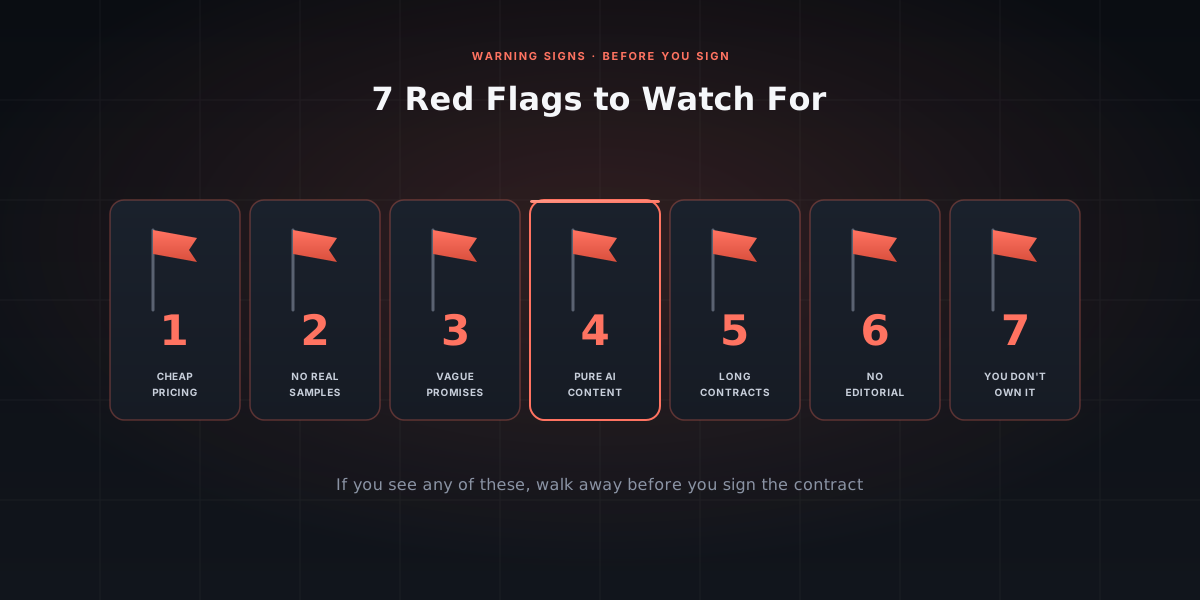
Here are seven red flags that should make you pause before you sign anything. I run a content agency, which means I see what bad agencies do to clients who leave them and come to us. Every single one of these patterns is something I have personally watched destroy a local business owner's trust in marketing.
Red flag 1: The price is too low to make sense
Pricing under $500 per month for ongoing content
If an agency is charging $200 to $500 a month for "four blog posts and SEO," do the math. A skilled writer charges $100 to $300 per article. Editorial review adds another $50. Strategy, keyword research, and publishing add another $100. Add the agency's profit margin and you cannot deliver real work at that price. Something is being cut. Almost always, it is the work itself. The articles come from pure AI generation, copy from competitor sites, or freelancers paid $25 per piece in countries where English is not their first language. Your local audience can tell. Google can tell. The traffic does not come.
Red flag 2: They cannot show you real samples
Stock screenshots, no live URLs, or recycled portfolios
Ask any agency for three live links to articles they have written for clients. A real agency will send them within an hour. If they hedge, say it is confidential, send only PDFs, or share a "portfolio" of stock images, walk away. Real agencies are proud of their work and want you to read it. The samples should also be recent. If everything they show you is from 2021, the team that produced that work may not even be there anymore.
Red flag 3: Vague promises with no specific deliverables
"We will grow your traffic" without saying how, when, or by what
A real proposal tells you exactly what you get each month. Four articles of 1,200 to 1,500 words each. One topic cluster per quarter. Monthly performance report. Quarterly strategy review. Specific keywords being targeted. If the agency cannot tell you those numbers in the sales call, they have not actually thought about your project. They are selling you a vibe. Vibes do not rank on Google.
Red flag 4: 100% AI-generated content with no editorial layer
The agency runs ChatGPT and ships the output
This is the biggest shift in content marketing right now. Cheap agencies use AI tools to generate articles, do zero editing, and ship them to clients. Google's Helpful Content Update specifically penalizes this kind of content. Sites that rely on it have been losing 30 to 80 percent of their organic traffic over the past two years. Ask any agency directly: "Do you use AI in your process?" The honest answer in 2026 is "yes, for research and outlines, but every article is written and edited by a human." If they say "no, we never use AI," they are lying. If they say "yes, our system generates the articles," run.
Red flag 5: They require a long contract before they have proven anything
12-month, 24-month, or auto-renewing commitments
A confident agency does not need to lock you in. If their work is good, you will stay. Long contracts exist for one reason: to keep you paying after you realize the work is not delivering. Look for month-to-month terms with a clear 30-day cancellation policy. If an agency insists on a year-long commitment, ask what happens if the content does not rank by month six. Most cannot answer that question, because they have no plan for that scenario.
Red flag 6: No editor, no strategist, no human oversight
One writer cranks out articles with no one reviewing them
Ask who edits the articles before publication. Ask who decides what topics to write about. If the answer is "the writer" or "our software," that is a one-person factory pretending to be an agency. Real editorial work needs a second set of eyes. Someone who catches the medical claim that needs a citation, the broken internal link, the headline that does not match the search intent. Without an editor, errors slip through. Errors hurt your credibility, especially in regulated industries like dental, medical, and legal.
Red flag 7: You do not own the content when the contract ends
The agency keeps copyright or migrates content off your site if you cancel
This one is brutal. Some agencies write your blog articles on their own subdomain or platform, then pull all the content when you stop paying. Suddenly your blog has 30 fewer articles and your Google rankings collapse overnight. Always confirm in writing that you own the content, it is published on your domain, and nothing is taken down if the relationship ends. The cleanest agencies will state this in their first proposal without you having to ask.
What a healthy agency relationship looks like
The opposite of these red flags is what you should be looking for. Mid-tier pricing somewhere between $1,200 and $3,000 a month. Live, recent samples sent within an hour. Specific monthly deliverables in writing. AI used for research only, never for finished articles. Month-to-month terms. A real editor reviewing every piece. And full ownership of everything you pay for, forever.
If you find an agency that hits all seven of those, you are in good hands. The work will still take three to six months to show real ranking results because that is just how Google works, but you will get there.
If you want a deeper look at what fair pricing should include at each tier, I broke it down in this article on what content agencies should cost. And if you are weighing whether you need an SEO agency or a content agency for your local business, that comparison is here.
Want to know if your current agency is doing the work?
Get a free content audit that scores your existing blog against these seven red flags. Branded PDF, yours to keep, no obligation.
Request Free AuditFrequently asked questions
