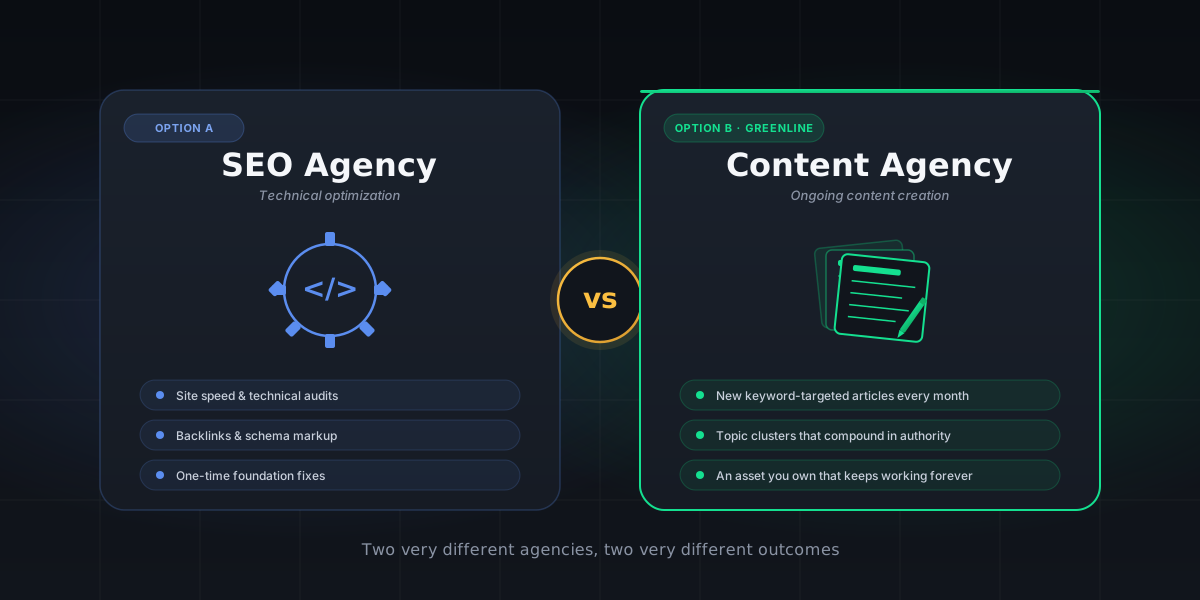
You know your business needs to show up better on Google. So you start researching agencies, and almost immediately you hit a wall. Some call themselves SEO agencies. Others call themselves content agencies. A few call themselves digital marketing agencies. And from the outside, they all seem to promise roughly the same thing: more traffic, more leads, more customers.
The truth is they do very different work. Choosing the wrong type for your business can mean spending thousands of dollars per month and seeing almost no results. So before you sign anything, you need to understand what each one actually does and which one fits your situation.
The short version
SEO agencies focus on the technical side of search engines. They optimize your existing website to make it faster, easier for Google to crawl, and structured to rank for keywords. They often work on backlinks, site architecture, page speed, and technical fixes.
Content agencies focus on creating new content that ranks. They research keywords, plan editorial calendars, write articles, and build out service pages and landing pages. The work is creative and strategic rather than technical.
Both are legitimate. Both can drive results. But they solve different problems, and most local businesses need one of them more than the other.
What an SEO agency actually does
A traditional SEO agency typically delivers some combination of these services:
- Technical audits. Reviewing your website for issues like slow load times, broken links, missing meta tags, mobile rendering problems, and duplicate content.
- Site speed optimization. Compressing images, optimizing code, configuring caching, and reducing the load time of pages.
- On-page optimization. Updating title tags, meta descriptions, header structure, and internal linking on your existing pages.
- Backlink building. Earning or acquiring links from other websites pointing to yours, which signals authority to Google.
- Local SEO setup. Optimizing your Google Business Profile, building citations, and managing local directory listings.
- Schema markup. Adding structured data to help Google understand what your pages are about.
SEO agencies tend to charge anywhere from $500 to $5,000+ per month depending on scope. Most of their work is one-time or quarterly: fix the technical issues, optimize the existing pages, set up the foundation, then maintain it.
The pattern most local businesses run into is this. The SEO agency does great work for two or three months, fixing real problems and improving the site's foundation. After that, the work tapers off because there is only so much technical optimization to do on a 15-page website. The agency keeps charging the monthly retainer but the actual work being delivered shrinks.
What a content agency actually does
A content agency operates on a fundamentally different model. The work is ongoing because the deliverable is new content created every month.
- Keyword research. Identifying the specific searches your potential customers make and prioritizing which ones to target.
- Content strategy. Building topic clusters and editorial calendars that align with your business goals.
- Article writing. Producing 4 to 12 SEO-optimized articles per month, depending on the package, with full editorial review.
- Landing page creation. Building or refreshing pages that target specific high-intent keywords for each service.
- Internal linking. Connecting articles and service pages to build topical authority and pass ranking power between pages.
- Performance tracking. Monitoring which articles rank, how traffic grows, and which keywords are driving leads.
Content agencies typically charge $1,000 to $5,000 per month for ongoing work. The model makes sense because new content is needed every month to keep building rankings, capture more keywords, and grow the asset.
The fundamental difference
SEO agencies
- Fix the foundation of an existing site
- Optimize what is already there
- Build backlinks and authority signals
- Set up local SEO infrastructure
- Address technical errors
Content agencies
- Add new pages targeting new keywords
- Expand the size of the website over time
- Build topical authority through depth
- Capture more searches month over month
- Create marketing assets that compound
Think of it like a building. An SEO agency is the contractor who fixes the foundation, repairs the wiring, and makes sure the structure is sound. A content agency is the developer who keeps adding rooms.
Both are useful. But once the foundation is fixed, more contractor work delivers diminishing returns. Adding more rooms keeps creating new value forever.
Which one does your business actually need?
Here is the honest test. Ask yourself which of these statements is more true for your business:
"My website has technical problems." Maybe it loads slowly. Maybe it has weird formatting issues on mobile. Maybe there are broken links or pages that show up wrong in search results. Maybe you have not updated the basics in five years. If this sounds like you, an SEO agency probably has the most leverage in the short term.
"My website is fine, but it does not show up on Google for the searches my customers make." The site loads. It looks decent. It works on mobile. It just does not rank for anything important. The pages you do have are about you, not about what your customers are searching for. If this is closer to your reality, a content agency is what you need.
For most local service businesses we talk to, the second statement is the truer one. Their website is fine, technically. The problem is they only have 8 pages, and 8 pages cannot rank for the hundreds of long-tail searches their customers are making.
Why do most local businesses need content over technical SEO?
Here is the part that surprises a lot of business owners. Modern website builders like Squarespace, Wix, WordPress with a decent theme, and Webflow all handle the basics of technical SEO automatically. Your site is probably already mobile-responsive, reasonably fast, and structured properly.
The technical foundation is not where most local businesses are losing. The content gap is.
If a chiropractor in Morristown has a website with 12 pages, and the dentist down the street has a website with 200 pages (because they have been blogging consistently for three years), the dentist will outrank the chiropractor on almost every relevant search even if the chiropractor has perfect technical SEO. Volume of relevant content beats technical perfection on a smaller site, every time.
This is why content marketing has become the dominant lever for local business SEO. The technical baseline is mostly handled by modern platforms. The content gap is where the real opportunity lives.
What about agencies that say they do both?
Some agencies claim to handle both technical SEO and content creation. A few do this well. Many do not.
The honest reality is that doing both at a high level requires two different teams of people. A great technical SEO specialist is rarely a great content strategist or writer. The skills do not naturally overlap. Agencies offering both at $2,000 per month usually deliver mediocre versions of both rather than excellent versions of either.
The cleaner approach for most local businesses is to fix the technical foundation once (which can often be done by your web developer or a one-time SEO consultant for $1,500 to $3,000) and then invest the ongoing budget into content creation through a focused content agency. You get the foundation handled and then put all the recurring spend into the work that compounds month after month.
Not sure which one your business needs?
Our free content audit shows you exactly where your website stands today, what is technically working, and what content gaps are costing you customers. Then you can decide what to invest in.
Get Your Free Content AuditFrequently asked questions
