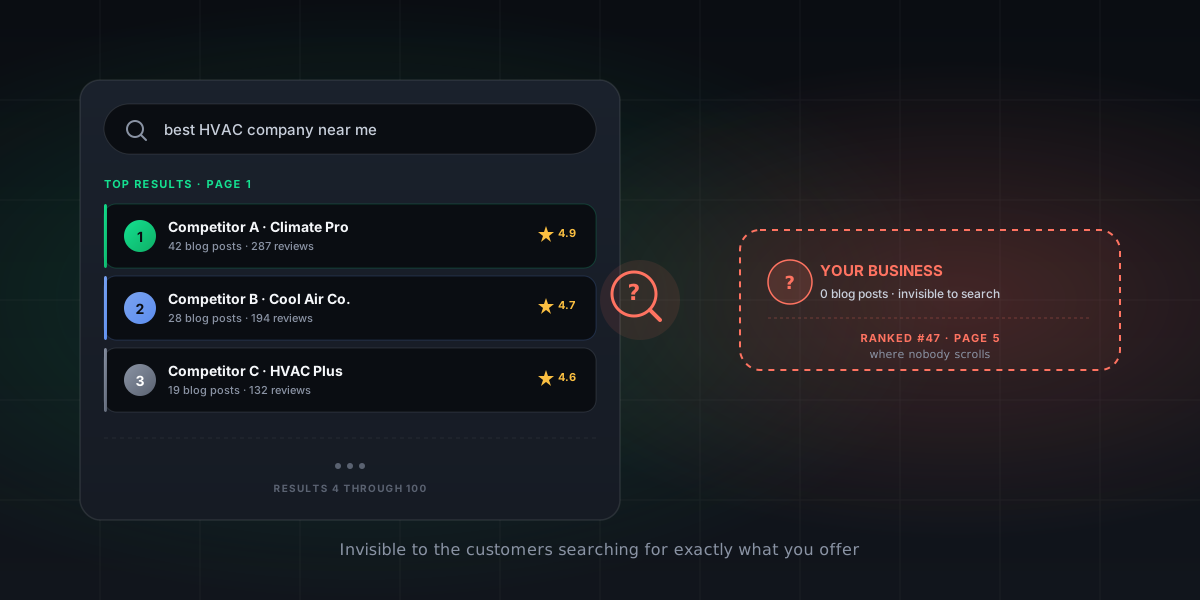
Here is a number that should bother every local business owner. Roughly 95% of all clicks from a Google search go to results on the first page. If your business shows up on page two, three, or not at all, you are effectively invisible to the people searching for exactly what you offer.
Most local businesses fall into this category. Not because their services are bad. Not because they lack reviews or a website. They are invisible because Google has no reason to rank them. Their website exists, but it does not answer the questions potential customers are typing into the search bar every single day.
That gap between having a website and actually showing up in search results is what we call a content gap. And closing it is simpler than most business owners think.
Why Google ignores most local business websites
Google's job is straightforward. Someone types a question. Google finds the best answer and puts it at the top. The websites that rank highest are the ones that most thoroughly, accurately, and helpfully answer the question being asked.
Most local business websites have five to fifteen pages. A homepage, an about page, a few service pages, and a contact page. Maybe a blog with three posts from 2021. That is not enough information for Google to consider the site an authority on anything.
Meanwhile, the competitor down the street has published 40 blog articles over the past two years. Each one answers a specific question their potential customers are searching for. Each article is another page Google can index, rank, and show to searchers. That competitor has 40 doors into their business. You have five.
Google is not picking favorites. It is rewarding the business that puts in the work to be the most helpful resource in its market.
The three biggest reasons local businesses do not rank
1. No content targeting local keywords
A chiropractor in Morristown with a website that says "We offer chiropractic care" is competing with every chiropractor in the country for the word "chiropractic." That is a losing game.
The same chiropractor with an article titled "Auto Accident Chiropractor in Morristown NJ: What to Expect at Your First Visit" is competing with maybe three or four other local practices for a very specific search that real patients are making right now. That is a winnable game.
Local keywords (your service plus your city or region) are the foundation of local SEO. Without content targeting them, Google has no way to connect your business with the people searching in your area.
2. Stale or nonexistent blog
Google tracks how recently a site was updated. A website that has not published new content in two years sends a signal that the business may not be active, relevant, or invested in helping searchers. Fresh content signals vitality.
This does not mean you need to publish daily. Four quality articles per month, published consistently, is enough to signal to Google that your site is alive and growing. The key word is consistently. A burst of 10 articles followed by six months of silence is less effective than steady, predictable publishing.
3. No depth on any single topic
Google rewards websites that demonstrate deep expertise on specific subjects. This is called topical authority. A dental practice that has published 15 articles about different aspects of dental implants (cost, recovery time, candidacy, alternatives, maintenance, insurance coverage, etc.) will rank higher for implant-related searches than a practice with one generic implant page.
Depth beats breadth. It is better to own one topic completely than to publish shallow articles across 20 unrelated topics.
The myth of "just doing SEO"
Many business owners have been told they need "SEO" and assume that means hiring someone to fix technical things on their website. Meta tags, site speed, mobile responsiveness, sitemaps. Those things matter, but they are table stakes. They get your site into the game. They do not win it.
Think of it this way. Technical SEO is like making sure your store has a door, a sign, and the lights on. Content is what fills the shelves. Without something valuable inside, nobody has a reason to walk in.
The businesses ranking on page one in competitive local markets almost always have two things in common: a technically sound website AND a steady stream of quality content targeting the searches their customers are making. One without the other caps your growth.
A simple 90-day plan to start ranking
Days 1 to 14: Research and plan. Identify the 20 to 30 keywords your potential customers are searching for in your area. Tools like Google Keyword Planner (free) or Mangools KWFinder ($29/month) make this straightforward. Focus on long-tail keywords with local intent. "Emergency HVAC repair Morris County NJ" is better than "HVAC repair."
Days 15 to 30: Publish your first four articles. Pick the four keywords with the best combination of search volume and low competition. Write one article for each, targeting that keyword in the title, headings, and body. Each article should be 800 to 1,500 words, answer the searcher's question thoroughly, and end with a clear call to action (book an appointment, call the office, request a quote).
Days 31 to 60: Publish four more and optimize. Add four more articles targeting your next best keywords. Go back to your first four articles and add internal links between them and to your main service pages. Submit all new URLs to Google Search Console so they get indexed quickly.
Days 61 to 90: Evaluate and adjust. Check Google Search Console for which articles are starting to appear in search results. Some will gain traction faster than others. Double down on the topics that are showing early ranking signals by publishing related articles that deepen your coverage of those subjects.
By day 90, you should have 12 published articles, a clear picture of which topics are gaining traction, and the beginning of a content library that compounds in value every month.
Want to see exactly where your website stands?
We will audit your site, your competitors, and the keywords in your market. Then we will show you exactly where the gaps are and what to do about them. Free. No obligation.
Get Your Free Content AuditFrequently asked questions
